Posts

Showing posts with the label Disney

Fred Moore, Where Are You?

Image
Let's see.  There's seven of these little guys.  Could it be?  Why yes!  It's the seven dwarfs.  Well, they're public domain, so anybody can use them, right?  What's that?  This is a Disney project?   DISNEY? Welcome to 7D , a new TV series for Disney Jr.   Quick!  Which one is Doc and which one is Happy?

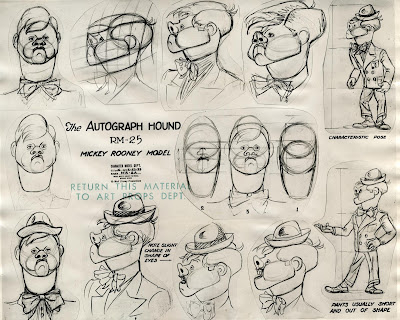
Mickey Rooney in The Autograph Hound (1939)

Image
The above model sheet is courtesy of Amid Amidi of Cartoon Brew , who wrote in the comments for The Autograph Hound , "In [animator Paul] Allen's defense, the Mickey Rooney design he was working from is one of the clunkiest and most poorly constructed Disney models of all time. I don't know what Joe Grant was thinking when he approved that one." I certainly have to agree with Amid.  The design is flat from both the front and side views. The only three quarter view on the model sheet doesn't work and is ugly to boot. As I mentioned earlier, caricature is difficult for a still, but even harder for animation where the likeness has to be able to turn.  Given this design, Paul Allen had a near impossible job.

The Autograph Hound (1939)

Image
It's been a while since I've done a mosiac.  When Hans Perk posted the animator draft for this cartoon, I knew I wanted to break it down visually. Donald Duck has never been a favorite animated character of mine.  Where there are certain of his cartoons I admire (such as Duck Pimples ), the admiration is based on things other than the character.  I know that many cartoon fans are not impressed with the Duck cartoons directed by Jack Hannah, but I actually like those the best overall, as I like Hannah's posing and timing as well as the work of animators like Al Coe. This cartoon is attractive to me because of the caricatures of Hollywood stars of the 1930s.  Caricature is difficult to do well with still illustrations.  When you start to move caricatures, the task of holding the likeness becomes even more difficult.  The success of the caricatures varies widely in this film. Paul Allen's Mickey Rooney is weak.  Looking at the animation single frame in o...

More Reasons Why Work-for-Hire Stinks

Another copyright case from the comics world, but one that has implications for people working in animation. Writer Gary Friedrich created Marvel's version of Ghost Rider . He sued Marvel claiming that it was created and offered to them and was not done as work for hire. He lost the suit. Previously, Friedrich commissioned artwork of the character which he sold at various comics conventions. Here's where it gets ugly: "As per the courts instructions Friedrich has to account for any and all money that he has received, “...relating to the gross and net amount derived from Plaintiffs' sale of goods bearing the Ghost Rider image, likeness, or Marvel trademark.” This means that Friedrich has to account for every cent each and every time he sold a print at a convention or any other item to anyone, that has the Ghost Rider image or name on it, and he has to account to all of the defendants in the case, and there’s quite a few of those, including, but not limited to...

Mini History Lesson

Profiles in History is having an auction entitled Icons of Animation on December 17. While the majority of items are out of my price range (maybe all of them actually), you can download a catalog of the auction for free. Even if you're not in the market to buy, the catalog is a mini history lesson by itself. It contains art from Disney, MGM, Warner Bros, Fleischer and Hanna Barbera. There is work by Bill Tytla, Fred Moore, Carl Barks, Bob Clampett, Virgil Ross, Irv Wyner, Mary Blair, Preston Blair, Gustav Tenggren, Charles Schulz, etc. There are worse ways to spend time than by paging through the download and admiring so much beautiful stuff. (link via Disney History )

Screen Captures

Image
From Galloping Gaucho From Peter Pan Disneyscreencaps.com features thousands of screen captures from shorts, features, and made for DVD films. It also includes work from Pixar and Dreamworks. I don't know if there's any rhyme or reason for the particular captures. It doesn't appear that they were selected by an animator. For all I know, the captures were done by an automated process. In any case, if you're looking for a handy visual reference from any of the films they've covered, it may be quicker than hauling out the DVD.

Disney Live Action Reference

Image
Someone known as lostvocals4 has taken live action footage from Operation Wonderland , a live action promotional piece that Disney made for Alice in Wonderland , and synched it up with the finished film. Disney was shooting live action reference footage at least as early as Snow White and the Seven Dwarfs . That procedure continued in the 1950s, especially because the budgets were tighter and the films had to be made more efficiently. Ed Wynn was filmed as the Mad Hatter and Jerry Colonna was filmed as the March Hare, with Kathryn Beaumont as Alice. What's interesting is that the audio from the reference footage was used as the final audio in the film. The artists on screen, in order of their first appearance, are Les Clark, Fred Moore (at left) with John Lounsbery, and Ward Kimball. If you want to see the entire Operation in Wonderland , which contains additional live action reference for the Walrus's dance and the march of the playing cards, you can see it here and here ....

Steve Jobs R.I.P.

Steve Jobs, founder of Apple and savior of Pixar, has lost his battle with pancreatic cancer. The official announcement is here . Jobs was also a major shareholder in Disney after he sold Pixar to Disney. While he clearly prepared Apple to continue without him, we'll have to see who inherits his Disney shares. In any case, John Lasseter and Ed Catmull have lost an ally and Robert Iger's hand is no doubt strengthened. Men like Jobs are rare and he will be missed. There was no one in the computer or electronics field to compare with him.

Disney Animators Who Sculpt

Image
I've been on the road for the last ten days: Las Vegas, the Grand Canyon, Monument Valley (second time!) and now Loveland, Colorado. I'm guessing that readers are scratching their heads over the final location, but this weekend was the occasion for two annual shows that attract hundreds of sculptors who display their work. As I've been sculpting for the last two years, I wanted to see what was being done. Sun Dog by Ellen Woodbury I knew that I'd see Ellen Woodbury at Sculpture in the Park . I met Ellen a year or so ago when she visited Sheridan College and I learned that she's now living in Loveland and sculpting full time. Ellen works in stone and her subject is animals , not a surprise given her animal animation at Disney on characters like Pegasus in Hercules . Reviewing the Troops by Mark Henn I did not expect to see Mark Henn , who participated in the Loveland Sculpture Invitational Show . Mark is still at Disney, having recently completed work on the W...

Kirby Estate Loses Copyright Battle

I am sure that this judgment will be appealed, but a Federal court has ruled that the work Jack Kirby did for Marvel was "work-for-hire." This is despite the fact that the legal term was not part of the copyright law at the time Kirby co-created characters such as The Fantastic Four , The Hulk , The Silver Surfer , Thor , etc. Here's the Associated Press story and here is Deadline Hollywood 's. While I am sure that there is a celebration occurring in the Disney and Marvel boardrooms as a result of this ruling, it's a questionable victory. When the artists at Marvel realized that the company was not going to compensate them beyond paying them by the page, they simply stopped creating new characters. Image Comics exists because a group of artists realized they would never be fairly compensated for their work at Marvel and so they formed their own company. Marvel's treatment of their artists has been consistently bad. See this article on the recently decea...

Oh Bother!

Image
"Sixth place? YOU'RE FIRED!" It's noon on Saturday as I write this, but Deadline Hollywood is estimating that the Winnie the Pooh film will finish sixth for the weekend with a gross of $8 million. No sane person expected the Pooh film to outgross the Harry Potter finale, but it's interesting that films two through five are hold overs. Pooh couldn't outgross Transformers 3 , Horrible Bosses , Zookeeper or Cars 2 . Cars 2 is in it's 4th week and may still outgross the Pooh film. That's bad as both are aimed at similar audiences of young children. The final domestic gross for the Pooh film should be somewhere between $20 and $32 million, depending on how it holds up. That will undoubtedly put downward pressure on the budgets of any future drawn films to come out of Disney as neither Pooh nor The Princess and the Frog have gotten close to the grosses for cgi films. I would be the last to blame the grosses on the fact that the films are dr...

Growth, Maturity and Decline

I haven't seen Cars 2 (and won't), but the critical drubbing it took and Pixar's move into sequels has me wondering about the bigger picture. Companies, like individuals, go through a life cycle. They grow, they mature and eventually they decline. The only difference between companies and individuals is that because companies can outlive individuals or change their personnel, they sometimes revive. Growth is a phase where companies get larger but also expand their skills and discover their point of view. If we look at the Disney studio during Walt Disney's lifetime, we can see growth from 1923 to 1942. We can argue the exact dates or films, but the overall pattern is clear. During that time period, the skills and what exactly a Disney cartoon was supposed to be continued to evolve. After Bambi , the studio was mature. A Disney cartoon was a particular, identifiable thing . When the studio deviated from that, in The Three Caballeros or Toot, Whistle, Plunk and ...

Tyrus Wong at the Walt Disney Family Museum

Image
From left to right: Tyrus Wong, Diane Disney Miller and Kim Wong, Tyrus's daughter. From left to right: Paul Felix (Disney animator), Tyrus Wong and Ralph Eggleston (Pixar art director) I wish that I could have attended this event. Tyrus Wong , whose style was a major influence on the look of Disney's Bambi , appeared at the Walt Disney Family Museum on June 11. Wong is now 100 years old and had a lengthy career in live action films after leaving the Disney studio.

Mars Needs Box Office

Image
The New York Times analyzes the failure of Mars Needs Moms : “Mars Needs Moms” may lead to the end for the Zemeckis style of motion-capture filmmaking, which has proven increasingly unpopular with audiences. Unlike the digital animation used by Pixar, in which movies are created entirely by computer, the Zemeckis technique requires actors to perform on bare sets while wearing uniforms outfitted with sensors to record their movements. Those movements are then transferred into a digital model that computer animators use to create a movie. Critics and audiences alike, with audiences voicing their opinions on Twitter, blogs and other social media, complained that the Zemeckis technique can result in character facial expressions that look unnatural. Another common criticism is that Mr. Zemeckis focuses so much on technological wizardry that he neglects storytelling.

Walt & El Grupo

Image
This is an excellent documentary chronicling the three month tour of South America by Walt Disney and assorted artists at the request of the U.S. State Department. With World War II already underway in Europe in 1941, the State Department was concerned that South America might align itself with the Axis powers, giving the Axis military bases on this side of the Atlantic Ocean. Their response, when the U.S. was still officially a neutral country, was to send cultural celebrities such as Disney (and, separately, Orson Welles) to South America to promote ties between North and South America. This documentary, now on DVD, is written and directed by Ted Thomas, the son of Disney animator Frank Thomas who was one of the artists on the trip. Other participants included Lee and Mary Blair, Jim Bodrero, Herb Ryman, Ted Sears and Norm Ferguson. As all of the participants have passed away, the documentary relies on the memories of spouses, children and grandchildren who have often saved lette...

Waking Sleeping Beauty: Requiem for a Studio

Image
Watching this film, I got the feeling that Don Hahn and Peter Schneider made it because they realized their best days were behind them and they were looking to celebrate and mourn the end of their greatest successes. This film covers the period of Disney animation history from the change in management in 1984, when Frank Wells, Michael Eisner, Roy Disney and Jeffrey Katzenberg took over from Ron Miller until Katzenberg's resignation after The Lion King . Because the film is bookended by these two changes in management, the film gives the impression that the rise and fall of the studio during this period was due to the people at the top. While they undoubtedly had a strong influence, such as deciding which films were made, the quality of those films was determined by the literally hundreds of people who created them. Those people are portrayed as bystanders to management politics and the film is curiously selective about who gets identified. I don't believe that Andreas Deja ...

Dumbo Part 25

Image
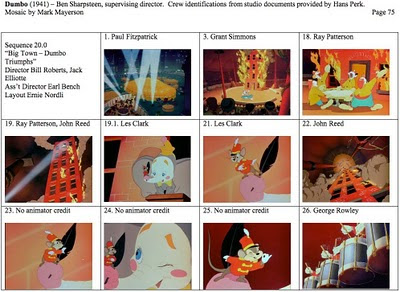
This sequence shows the aftermath of Dumbo's flying. The montage is a great snapshot of the public's preoccupations at the end of the 1930's. Dumbo setting an altitude record relates to the public's ongoing romance with aviation at the time. People like Charles Lindbergh, Amelia Earhart, and Wiley Post were all celebrated aviators of the period (the latter two dying in flight). "Dumbombers for defense" relates to the war in Europe, which the United States would join in 1941. The Hollywood contract had been sign of success at least since the 1910s, when performers started to make big money and in the '30s, movies and radio were the two major mass media. Dumbo's contract also explains Timothy's absence from the final scenes. What follows the montage is the transformation of the circus. There have previously been scenes of Casey, Jr. in dark and stormy weather. He's now bedecked with flowers and chugging effortlessly in the bright sunlight. ...

Dumbo Part 24

Image
Finally, Dumbo triumphs and shows his worth. Note the large gap between shots 3 and 18. The missing shots that are on the draft are all of the clown fireman arriving and preparing to fight the fire. The Disney studio wisely decided not to delay Dumbo's triumph any more than necessary. Now that the audience knows Dumbo can fly, they are waiting to see the secret revealed and wonder how it will affect Dumbo's life. The idea of the magic feather is frankly hokey, but it serves an important storytelling purpose. It's a convenience for the film makers, as Dumbo should not believe in the feather as he didn't have it before waking up in the tree. It's more logical to believe that Dumbo's "magic feather" should be alcohol. However, because the audience knows Dumbo can fly, there would be no suspense in this sequence without some way to cast doubt on his eventual success. As Dumbo believes in the feather and he loses it during his descent, the audience i...

Dumbo Part 23

Image
While there are nice bits of animation in this sequence, this section is really dominated by story and layout. The way in which the audience learns that Dumbo can fly is quite inventive. Rather than see a take-off, the screen is obscured with dust, Timothy is convinced they've failed and then the audience sees Dumbo's shadow on the farmlands below. This image is one that could only exist in a period when commercial air travel existed or the audience (and the artists) could never have conceived of such a shot. The other great piece of layout is shot 28, where Dumbo lands on the phone wires. That's another shot that depends on the widespread use of a technology. Will future audiences understand what those wires are when all they know is cell phones? I'm assuming that Don Towsley animated the bending poles. It's a thankless task; what could be more boring? Yet the shot always gets a laugh. Towsley's Dumbo still has a pinched face, where the features are too ...

Dumbo Part 22

Image
Except for two shots, one by Walt Kelly and the other by Don Towsley, Ward Kimball and Fred Moore dominate this sequence. Kimball does the entire song, "When I See an Elephant Fly" (except for Kelly's shot 22), including shots of Timothy. Then Moore takes Timothy over for his heartfelt recitation of Dumbo's troubles. Once again, the film is powered by contrast, this time moving from the upbeat song to the plea for understanding. Was Kimball ever better than this and his work in Pinocchio ? The music here allows him to be as broad as he wants to be while the crows' reaction to a flying elephant is perfectly reasonable. As much as I love Kimball's work, there are times I feel his broadness pulls me out of a film. His work here and in Pinocchio has an emotional grounding that keeps him functioning as part of the story. All of Kimball's strengths are on display here: brilliant posing, fantastic accents and eccentric movements. The bottom half of the c...